

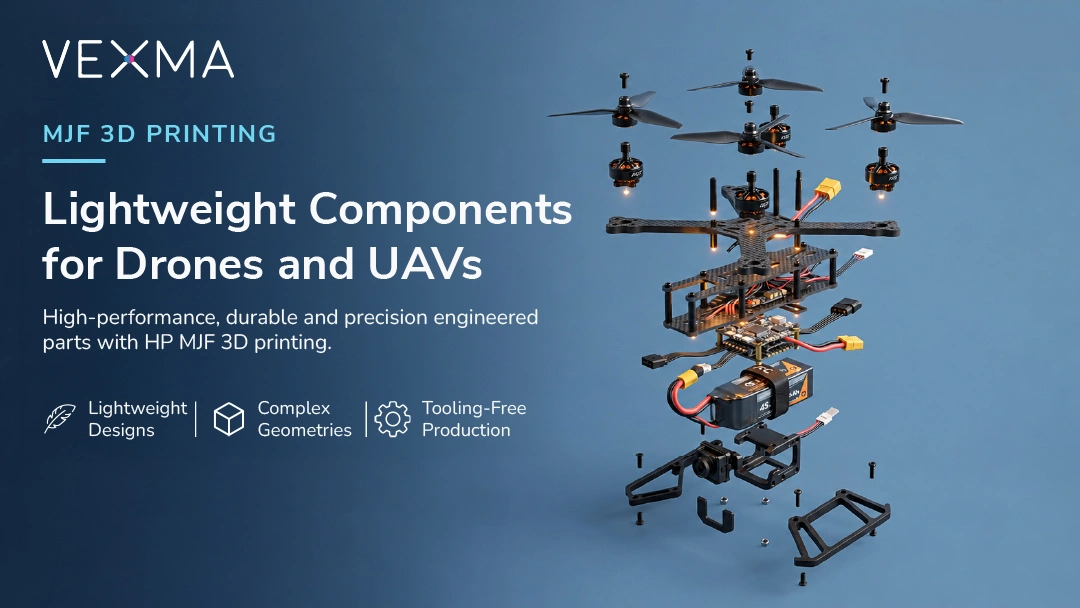
MJF 3D Printing for Drones and UAVs: Lightweight Components for Imaging Systems
Unmanned Aerial Vehicles (UAVs) and drones require lightweight, durable, and precisely designed components to support flight performance, imaging systems, and payload integration. As drone applications expand across industrial inspection, aerial surveying, agriculture, mapping, and surveillance, manufacturers increasingly need components that accommodate evolving design requirements without the cost and lead time of conventional tooling.
MJF 3D printing offers a practical manufacturing solution for producing functional polymer components, including drone arms, airframe parts, camera housings, gimbal enclosures, and avionics covers. Through 3D printing solutions for drones and UAVs, manufacturers can explore tooling-free production for customized components and low-volume manufacturing.
Reducing UAV Camera System Weight with 3D Printing
Camera systems are essential to many UAV applications, from aerial imaging and infrastructure inspection to mapping and remote monitoring. Their supporting components must provide structural stability while keeping additional weight to a minimum.
MJF 3D printing enables the production of lightweight, application-specific camera mounts, protective housings, brackets, and support structures. Components can be designed around camera dimensions, mounting points, cable routing, and integration requirements.
Through design optimisation, manufacturers can reduce unnecessary material while retaining the structural features required for the intended application. Lower component weight can help manage the overall UAV payload, although actual flight-performance benefits depend on the complete aircraft design.
Explore custom 3D-printed components for drone applications to understand how additive manufacturing can support UAV component development.
Custom Gimbal Enclosures for UAV Imaging Systems
Gimbal assemblies help stabilize cameras and imaging sensors during drone operation. Their enclosures must accommodate mechanical interfaces, moving components, wiring, and sensor integration while protecting sensitive equipment from environmental exposure.
MJF makes it possible to manufacture custom gimbal enclosures and imaging-system housings based on specific design requirements. Complex shapes, integrated mounting features, and tailored internal clearances can be incorporated without dedicated moulds.
This flexibility is particularly useful when developing new camera configurations, modifying existing assemblies, or producing customised enclosures for specialised UAV platforms. Designs can be updated digitally, allowing revised components to be manufactured without investing in new injection-moulding tools.
MJF-Printed Drone Arms and Airframe Components
Drone arms and airframe components must balance weight, stiffness, geometry, and mounting requirements. MJF can support the production of selected polymer structural components, brackets, connector housings, and customised airframe parts.
Using CAD-based design and additive manufacturing, engineers can explore different geometries, incorporate functional features, and consolidate selected parts where the application permits. These approaches can simplify assembly and support design adjustments during product development.
Explore Vexma Technologies' 3D printing work and manufacturing applications to see how additive manufacturing can support the development of functional components across different industries.
Material selection and component validation remain essential, particularly for parts exposed to vibration, impact, repeated loading, or demanding operating conditions. Components must be evaluated against the specific mechanical and environmental requirements of the UAV.
Avionics Enclosures and Payload Housings
UAV platforms often integrate flight-control electronics, communication modules, sensors, batteries, and application-specific payloads. These systems require enclosures that accommodate electronic layouts, connectors, mounting features, and cable access.
MJF enables the production of custom avionics enclosures and payload housings with application-specific dimensions and integrated design features. This is valuable for specialised UAV platforms where standard off-the-shelf housings may not meet packaging or integration requirements.
Depending on the material and design, additional measures may be needed to meet requirements for thermal management, electromagnetic compatibility, weather resistance, or protection against dust and moisture.
For manufacturers exploring customised drone components, Vexma's 3D printing solutions for UAV applications provide a starting point for discussing application-specific manufacturing requirements.
Tooling-Free Production for Design Changes and Low-Volume Manufacturing
Drone development often involves frequent design changes as engineers refine component layouts, improve payload integration, or adapt platforms for different applications. Traditional manufacturing methods that require dedicated tooling can make these revisions expensive or time-consuming.
MJF 3D printing offers a tooling-free alternative for suitable polymer components. Updated CAD files can be used to produce revised parts without creating new molds for every design iteration.
Key advantages include:
-> Rapid design iterations: Evaluate revised geometries and component configurations.
-> Customised production: Adapt housings, mounts, and brackets to specific UAV platforms.
-> Low-volume serial manufacturing: Produce repeat batches of functional parts without dedicated injection-moulding tooling.
-> Part consolidation: Combine selected features into fewer components where technically appropriate.
-> On-demand manufacturing: Manufacture parts according to project requirements and production schedules.
For UAV manufacturers, these capabilities can help bridge the gap between prototype development and low-volume production of end-use components.
Why Choose MJF 3D Printing for UAV Components?
MJF is suited to applications where complex geometries, repeatable production, and design flexibility are important. Depending on the component and material selected, the technology can support functional polymer parts with detailed features and consistent production workflows.
Potential applications include:
-> Lightweight camera mounts and imaging-system supports
-> Custom gimbal enclosures
-> Drone arms and selected airframe components
-> Avionics and electronics housings
-> Payload covers and sensor enclosures
-> Cable guides, brackets, and integration components
The right manufacturing approach depends on the component's loading conditions, operating environment, dimensional requirements, and production volume. Engineering assessment and application-specific testing help determine whether MJF is suitable for each part.
Conclusion
As UAV designs evolve, manufacturers need production methods that support lightweight component design, custom integration, and flexible manufacturing volumes. MJF 3D printing provides an option for producing drone arms, airframe components, camera mounts, gimbal enclosures, avionics housings, and specialised payload components without dedicated moulds.
By combining design flexibility with tooling-free production, MJF can help UAV manufacturers accommodate design changes and manufacture low-volume serial batches.
Looking to reduce UAV camera-system weight or develop custom gimbal enclosures and other drone components?
Explore our 3D printing solutions for drones and discuss your component design, material requirements, and manufacturing needs with our team.
Discuss Your Application: 👉Get an Instant Quote
You can also explore High-quality metal parts 3D printed at Vexma for defence applications - Explore Our Metal 3D Printing Solutions


