

HP MJF 3D Printing for Automotive Production: From CAD Design to Quality Inspection
When automotive manufacturers need production parts quickly, traditional tooling can introduce significant lead times. Industrial 3D printing offers an alternative by enabling manufacturers to produce functional components directly from digital designs without relying on conventional molds.
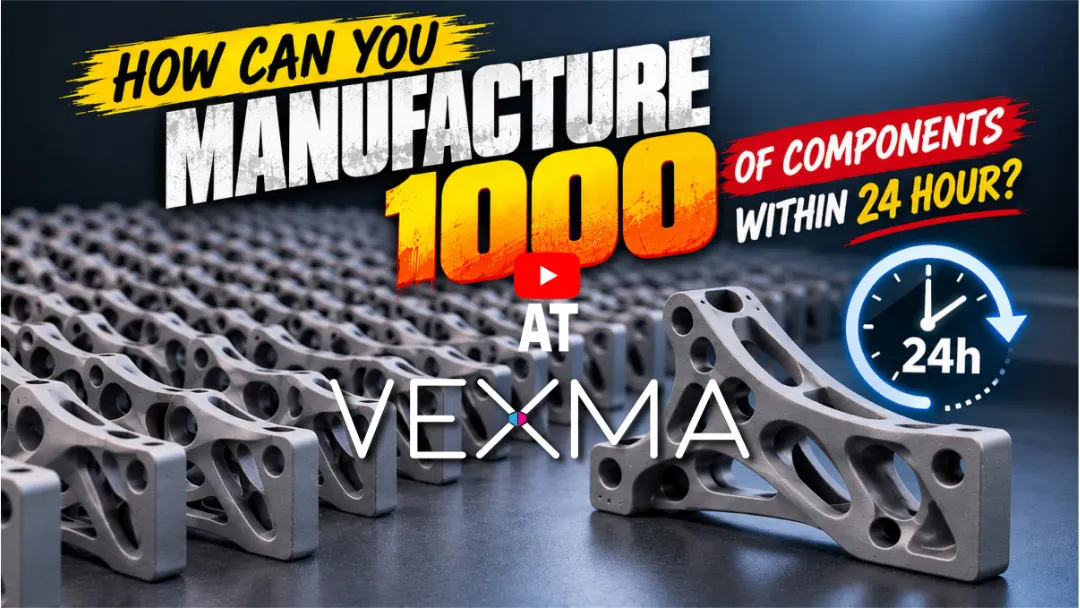
At Vexma Technologies, we use HP Multi Jet Fusion 3D printing to manufacture polymer components through a connected digital workflow, from build preparation and part nesting to post-processing and final quality inspection. In our latest video, we take you inside the MJF production process to demonstrate how automotive parts move from CAD design to finished components ready for delivery.
What Is Multi Jet Fusion 3D Printing?
HP Multi Jet Fusion is an industrial polymer 3D printing technology designed for producing functional parts with consistent detail and repeatability. It uses a powder-based process in which fusing and detailing agents are selectively applied to material layers and energy is used to fuse the material into solid components. For automotive manufacturing, it can support functional prototypes, custom components, production aids, replacement parts and low- to medium-volume production, depending on the application and its requirements.
One of its key advantages is the ability to manufacture complex geometries directly from digital files, reducing dependence on dedicated tooling for suitable applications.
Automotive 3D Printing Workflow
1. CAD Preparation and Part Nesting: The production process begins with digital part preparation. Before printing, components are arranged within the available build volume through a process known as 3D printing part nesting. Effective nesting helps maximise build utilisation by positioning multiple components within a single build while maintaining appropriate spacing and considering part geometry, orientation and processing requirements. For automotive part manufacturers, efficient build planning can help improve production throughput and make better use of available machine capacity.
2. Build Preparation and 3D Printing: Once the build layout is finalised, the prepared files are sent to the HP Multi Jet Fusion 3D printer. The machine processes successive layers of polymer powder, selectively applying fusing and detailing agents to create the intended geometry. This layer-by-layer process transforms digital designs into physical components. Unlike conventional manufacturing methods that may require dedicated molds, MJF 3D printing produces parts directly from digital data, making it suitable for applications where design flexibility and tooling independence are important.
3. PA12 Nylon Parts After Printing: After the printing cycle, the build unit contains the manufactured parts within the surrounding powder bed. PA12 nylon is a widely used material for this application because of its combination of mechanical performance, durability and suitability for functional polymer components. Depending on the design and application, PA12 parts can be considered for automotive housings, brackets, covers, fixtures and other functional components. Material selection should always be based on the required mechanical properties, operating environment and application-specific validation.
4. Depowdering and Surface Finishing: Printing is only one stage of the production process. Once the build is ready for unpacking, excess powder must be removed from the components. The parts are then cleaned and undergo appropriate post-processing. Blasting can help remove residual powder and improve surface consistency, depending on the selected finishing method. These steps are important for preparing 3D printed components for handling, inspection and their intended downstream use.
5. Quality Inspection Before Delivery: Quality inspection is an essential part of industrial 3D printing production. After post-processing, components are checked against the applicable requirements. Depending on the project, inspection may include dimensional verification, visual examination, surface-finish checks and other application-specific quality checks. This helps ensure that the finished components meet the agreed specifications before they are delivered to the customer. At Vexma Technologies, the objective is to integrate manufacturing and post-processing into a coordinated workflow that supports reliable production and customer requirements.
Why Use HP MJF 3D Printing for Automotive Parts?
Automotive manufacturers must balance production speed, part quality, design flexibility and manufacturing costs.
It can offer several advantages for suitable applications.
• Reduced tooling dependency:
Produce eligible components directly from digital designs without dedicated molds.
• Efficient batch production:
Nest multiple components in one build to make effective use of the available build volume.
• Design flexibility:
Manufacture complex geometries that may be difficult or costly to produce using conventional methods.
• Functional polymer components:
Use materials such as PA12 nylon for suitable engineering and production applications.
• Digital workflow:
Move from CAD preparation to printing, finishing and inspection through a connected manufacturing process.
• Production flexibility:
Support design iterations, customised parts and selected low- to medium-volume production requirements.
From CAD to Production: Digital Manufacturing at Vexma Technologies
This workflow demonstrates how industrial 3D printing extends beyond prototyping into the production of functional polymer components. By combining digital part preparation, optimised nesting, powder-based printing, post-processing and quality inspection, manufacturers can establish a structured route from a CAD model to a finished physical part.
At Vexma Technologies, we combine industrial 3D printing, engineering and advanced manufacturing capabilities to support metal and polymer component production. Our approach integrates digital workflows with manufacturing operations to help customers evaluate suitable production methods for their specific applications.
Looking for Polymer 3D Printing Services?
Need functional polymer components, automotive 3D printed parts or industrial production support? Connect with Vexma Technologies to discuss your design, application requirements and manufacturing goals.
Talk to our experts: 👉Get an Instant Quote


