

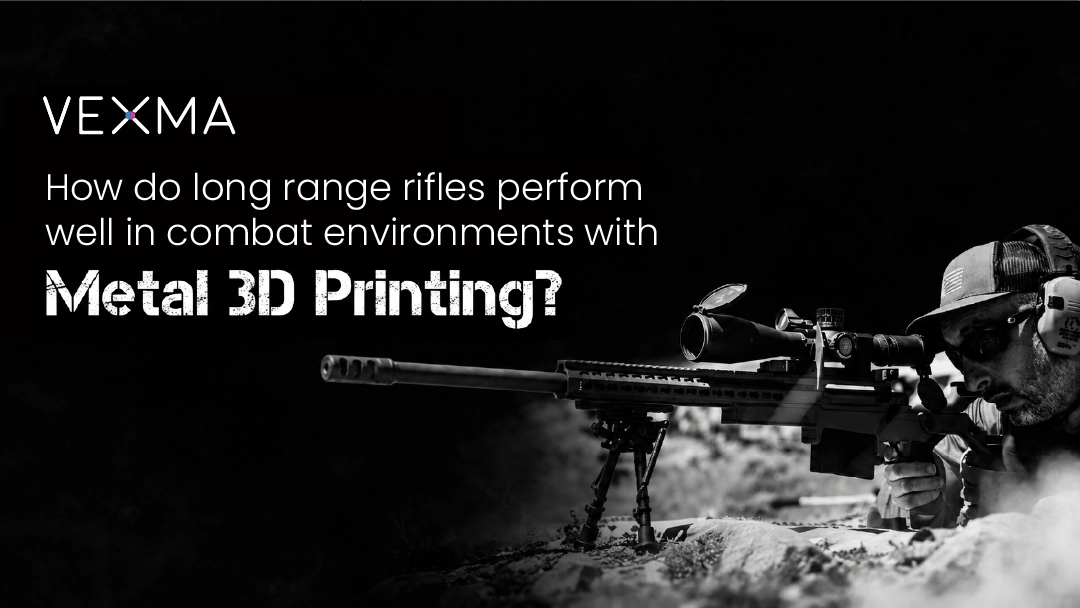
How Metal 3D Printing Is Transforming Long-Range Rifle Manufacturing
The defense and aerospace industries are increasingly exploring advanced manufacturing technologies to produce lightweight, complex, and high-performance metal components. Among these technologies, Metal Additive Manufacturing (Metal AM) is creating new possibilities for component design, material utilization, and production flexibility.
Traditional manufacturing methods, including CNC machining and casting, remain essential for firearm production. However, they can present limitations when manufacturing parts with complex internal features, intricate geometries, or highly optimized structural designs.
Metal 3D printing offers an alternative approach by building components layer by layer from digital models. For manufacturers working on precision equipment and long-range rifle systems, this technology can support design exploration, functional prototyping, and the production of specialized metal components.
How Can Metal 3D Printing Support Defense Manufacturing?
Long-range rifle systems require components that balance dimensional accuracy, structural strength, weight, and durability. Metal additive manufacturing provides engineers with greater freedom to explore designs that may be difficult, expensive, or time-consuming to produce using conventional methods. Its potential applications in defense manufacturing include:
1. Optic Mounts and Accessory Structures: Optic mounting systems and accessory structures require reliable dimensional accuracy and mechanical stability. Metal AM allows engineers to explore lightweight structural designs and consolidate certain features into fewer components. These capabilities can support design iteration and the development of specialized mounting structures, subject to appropriate material qualification and dimensional inspection.
2. Lightweight Structural Components: Reducing component weight without compromising required strength is an important consideration in defense equipment design. Metal 3D printing enables the production of complex structural geometries that can be difficult to achieve through conventional subtractive manufacturing. With engineering analysis and topology optimization, designers can investigate opportunities to reduce unnecessary material while retaining the required load-bearing characteristics.
3. Complex Metal Geometries: Conventional machining can become challenging when components include intricate features, curved surfaces, or difficult-to-access internal geometries. Metal additive manufacturing can produce certain complex shapes directly from digital designs, reducing the need for multiple machining operations or assemblies. The final design must still account for process limitations, surface quality, dimensional tolerances, and post-processing requirements.
4. Custom Engineering Prototypes:
Before a component enters production, engineers need to evaluate its geometry, fit, assembly requirements, and manufacturability.
Metal AM supports the development of engineering prototypes and design iterations without requiring
dedicated tooling for every design change. This can help manufacturers evaluate concepts and refine
components before committing to larger-scale production processes.
Which Metal 3D Printing Applications Are Relevant to Defense and Aerospace?
Metal additive manufacturing is used or evaluated for various industrial applications, depending on the technology, material, and qualification requirements. Examples include
• Aerospace structural and mechanical components
• Equipment housings and mounting structures
• Thermal management components for suitable aerospace systems
• Functional engineering prototypes
• Specialized low-volume metal components
For defense applications, components must meet the relevant dimensional, mechanical, environmental, and regulatory requirements before deployment.
How Is Quality Assured in Metal Additive Manufacturing?
Quality assurance involves more than producing the correct geometry. Material consistency, process control, post-processing, and inspection are essential to reliable manufacturing.
For safety-critical aerospace and defense components, traceability, documented testing, and appropriate qualification are essential.
What Should Manufacturers Consider Before Adopting Metal AM?
Before introducing metal additive manufacturing, manufacturers should evaluate:
Application requirements: Define operating conditions and performance expectations.
Material selection: Assess mechanical properties and environmental suitability.
Manufacturing feasibility: Review geometry, build size, and post-processing needs.
Total cost: Compare material, production, finishing, and inspection expenses.
Quality and compliance: Establish testing, traceability, and qualification requirements.
This evaluation helps determine whether metal AM offers a genuine advantage over alternative manufacturing processes.
How Can VEXMA Support Metal Additive Manufacturing Projects?
VEXMA supports industrial customers exploring additive manufacturing for complex geometries, functional prototypes, and specialized component production. Our approach focuses on understanding project requirements, selecting suitable manufacturing processes, and evaluating post-processing and inspection needs. For aerospace and defense-related projects, process selection must align with material specifications, component requirements, and applicable qualification standards.
Looking to explore metal additive manufacturing for your next engineering project?
Talk to our experts: 👉Get an Instant Quote


